

Static content is reaching its ceiling. Attention spans are shortening, content saturation is climbing, and scroll fatigue is real.
The shift is happening now: from passive content to interactive, visual-first experiences.
This isn’t stylistic—it’s strategic. The numbers prove it.
📊 The Data Speaks — and It’s Visual
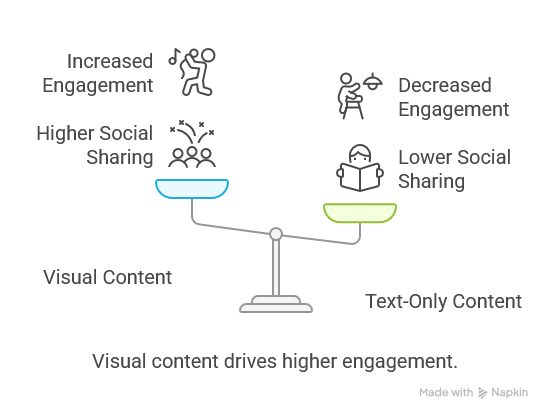
- Visual content is 40x more likely to be shared on social media (Buffer).
- Interactive content gets 2x more engagement than static content (Content Marketing Institute).
- Posts with visuals get 650% higher engagement than text-only ones (MarketingSherpa).
That’s not marginal improvement. That’s a performance gap. And it’s widening.
🎯 Strategy Update: From Consumption to Participation
Old content playbooks focused on volume. New strategy? Focus on involvement.
✅ Interactive formats that work:
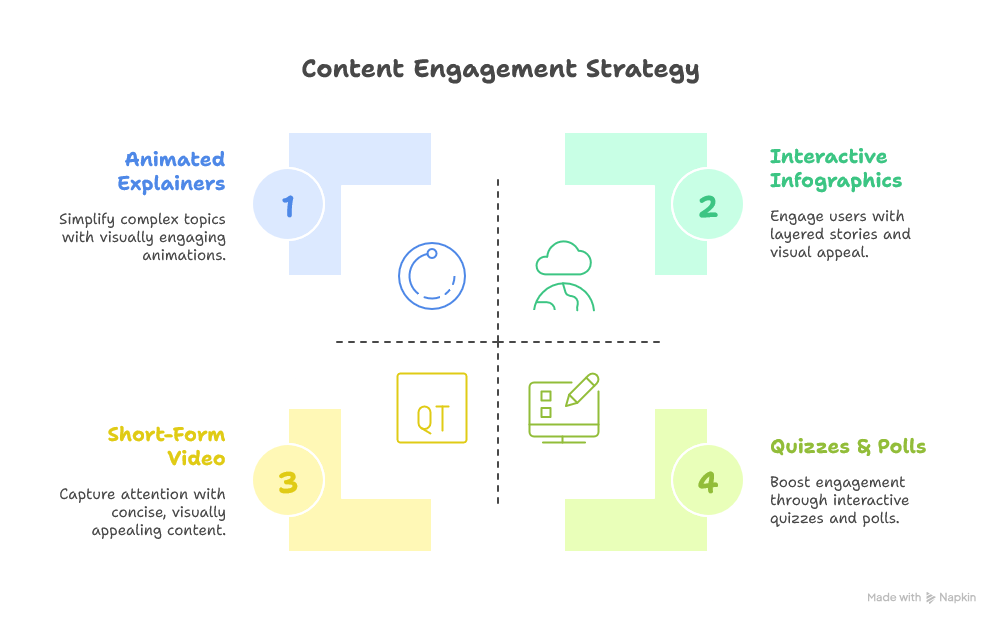
- Quizzes & polls: Boost time-on-page and double conversion rates.
- Calculators & product finders: Deliver personalized value in seconds.
- Interactive infographics: Tell layered stories without overwhelming.
✅ Visual formats that convert:
- Short-form video (Reels, TikTok, Shorts): Higher retention + algorithm boost.
- Carousels (LinkedIn, Instagram): Maximize dwell time through swipe logic.
- Animated explainers: Simplify complexity and drive CTA clicks.
Engagement now means motion, response, choice—not just views.
💡 Why It Works: Cognitive Load + Control
Interactive and visual content performs because it reduces friction and increases agency.
- People process visuals 60,000x faster than text (3M Research).
- Users are 3x more likely to engage with content they can manipulate (DemandGen).
- Adding interactive elements increases content recall by up to 78% (Ion Interactive).
The goal isn’t just to inform—it’s to involve. Engagement is built through experience, not explanation.
⚙️ Execution: Where to Start, What to Use
Rule: If your content can be static, ask how it could be interactive. If it’s visual, ask how it could be dynamic.
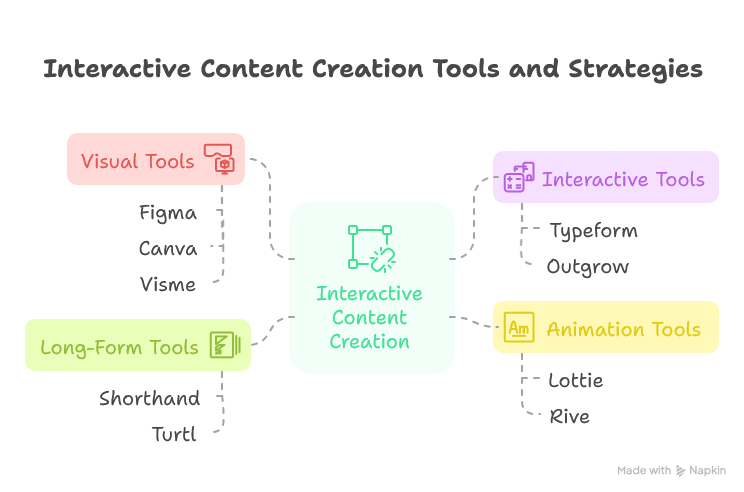
Tools to enable at scale:
- Figma, Canva, Visme → for interactive visuals and social assets
- Typeform, Outgrow → for quizzes, calculators, and micro-experiences
- Lottie, Rive → for lightweight animation that doesn’t kill page speed
- Shorthand, Turtl → for long-form, scroll-driven experiences
No-code and low-code tools are making high-quality interactive content accessible, even for lean teams.
📌 Bottom Line: What Matters Now
- Visual content = more attention
- Interactive content = more action
- Combined = higher ROI per asset
Content that performs today is modular, dynamic, and user-responsive. It doesn’t just deliver a message—it creates a moment.
Final Numbers
- 88% of marketers say interactive content differentiates them from competitors (DemandGen).
- Visual storytelling increases conversion rates by up to 86% (Neil Patel).
- 81% of brands using interactive content say it’s more effective at grabbing attention than static (Content Marketing Institute).
Create with movement. Design for response. Format for action. That’s what modern content strategy looks like.